

Getting Around Spain: The Complete Public Transport Guide for Tourists
-
Reservations
Flights
-
Airport to City
Varies
-
City Tours
Book Now
-
Currency:
Euro
-
Spain
7-Day Itinerary
-
Avg. UK Fly Time
2.5 Hrs
How to Travel Around Spain as a Tourist
This guide unlocks Spain's transport network
Spain's public transport is faster, cheaper, and more interesting than most visitors expect. This guide cuts through the confusion and shows you exactly how to use it, city by city, journey by journey, from your first metro ride to your last long-distance coach. Read on to find out more:
Many first-time visitors to Spain find it easy to book cheap flights and often arrive with a loose plan to take taxis or local buses, and figure things out as they go. This works, but it costs more money, wastes more time, and misses one of Spain's genuine pleasures. The public transport network here is excellent. Use it properly and you save money, arrive faster, and see more of the country than any taxi could show you.
Why Public Transport Works Well for Tourists
Spain has metro systems in eight cities, more than 4,000 bus routes connecting over 5,000 towns and villages, a high-speed rail network that covers most major destinations, trams in 13 cities, and tourist passes that cut daily transport costs to almost nothing. The challenge is knowing which option works best where. That is what this guide is for.
1. Spain's National Train & Coach Networks Explained
The AVE High-Speed Train: Spain's Best Inter-City Transport
The AVE (Alta Velocidad Espanola) is Spain's high-speed rail network, operated by Renfe. It is the fastest and most comfortable way to travel between Spain's major cities, and it makes multi-city touring genuinely easy.
Key routes and journey times:
- Madrid to Barcelona: 2 hours 30 minutes. Runs multiple times daily.
- Madrid to Seville: 2 hours 20 minutes. One of the busiest routes in Europe.
- Madrid to Valencia: 1 hour 40 minutes.
- Madrid to Malaga: 2 hours 20 minutes.
- Barcelona to Valencia: 3 hours 10 minutes.
- Seville to Cordoba: 45 minutes by AVE. One of the easiest and best-value day trips in Spain.
The experience itself is worth noting.
- AVE trains are quiet, punctual, and comfortable.
- There is plenty of legroom, a food service on longer routes, and you arrive at central city stations rather than out-of-town airports.
- For trips under 3 hours between major cities, it almost always beats flying once airport transfer time is included.
Tickets & Booking
- Book through Renfe (renfe.com), or via Omio, or the Renfe app. Advance fares are significantly cheaper than walk-up prices.
- Book at least one week ahead on popular routes. For peak season travel, three to four weeks is safer.
- Advance fares start around 25-30 euros for Madrid-Seville. Walk-up fares can reach 90-100 euros on the same route.
- Carry your booking reference or print the ticket. Spanish rail staff do check tickets on board.
Flight4 Pro Tip: The Renfe Youth Card offers discounts on AVE fares for travellers under 26. Worth purchasing if you are planning multiple long-distance train journeys.

Long-Distance Coach: ALSA & The Intercity Bus Network
Spain's long-distance coach network is extensive and affordable. ALSA is the dominant operator, covering routes nationwide. For routes not served by AVE, or for travellers on a tighter budget, coaches are a reliable alternative.
Key Coach Route Examples:
- Seville to Granada: ALSA operates direct coaches approximately every 2 hours. Journey: around 3 hours. Tickets from 12-22 euros. A new direct train service (Renfe Avant) operates on this route that takes about 2 hours 30 minutes.
- Granada to Malaga: ALSA runs direct services. Journey: approximately 1 hour 45 minutes. Useful for accessing Malaga Airport without going back to Seville.
- Madrid to Barcelona: Coach takes around 8 hours. AVE at 2.5 hours is a far better choice here, but the coach is cheaper, from around 15 euros with advance booking.
- Smaller towns and villages: For destinations not served by rail, ALSA and regional operators provide the only scheduled public transport option. Most Spanish provincial capitals and many smaller towns have at least one daily service.
Book ALSA tickets at alsa.es, by the Alsa app, or at bus station ticket windows. The main long-distance bus station in Madrid is Estacion Sur (Mendez Alvaro). Seville: Plaza de Armas is now the primary hub for most long-distance and regional services, including ALSA routes to Granada, Malaga, and Madrid. Prado de San Sebastián has become more specialised, handling specific regional routes toward Cádiz and some smaller Andalusian towns.
Flight4 Pro Tip: Coaches in Spain are generally comfortable, air-conditioned, and punctual. For night journeys, long-distance services often include reclining seats and a quieter journey than the equivalent train. Note: Cheaper train fares are starting to catch-up with coach ticket prices.
2. Spain's City Transport Networks Explained
Metro Systems: The Backbone of City Travel
Spain's metro networks are among the best in Europe for tourists. They are fast, clean, affordable, and cover almost every major attraction in the cities they serve. For daily sightseeing, they are consistently the best choice over taxis or buses.
Madrid Metro:
Madrid's metro is one of the largest in Europe, with 13 lines, over 300 stations, and a total network length of 302 kilometres. It runs daily from 6am to 1:30am.
- Single ticket: €1.50 and €2.00 depending on distance.
- Tourist Travel Pass (Titulo Turistico): Starts at €10.00 for 1 day (Zone A). Covering unlimited travel on metro, buses, light rail, and Cercanias within the city. Available for 1, 2, 3, 4, 5, or 7 days. Both Zone A (city only) and Zone T (entire region) options are available.
- The pass includes airport metro travel at no extra cost, eliminating the usual 3-euro airport supplement on a standard single ticket.
- Buy at any metro station ticket machine, at the airport, or at CRTM offices at Sol and Atocha stations.
- Children under 11 receive a 50% discount on the tourist pass.
The Tourist Pass is loaded onto a reloadable Multi Card (a red plastic smartcard), which costs 2.50 euros but is included free when you load a tourist pass onto it. Once your pass expires, the card continues to work with pay-per-ride top-ups.
Flight4 Pro Tip: The Madrid Tourist Travel Pass is personal and non-transferable. Each person in your group needs their own card.
Barcelona Metro:
Barcelona's metro runs 11 lines with 164 stations, operated jointly by TMB and FGC. It runs until 2am on weekdays, on Saturdays, the metro runs continuously (24 hours) until Sunday at midnight.
- For tourists, the T-Casual card (10 trips, €13.00) offers the best value for short stays. It works on metro, buses, and trams within Zone 1.
- The T-Jove (youth card, for under 30s) and T-Usual (monthly pass) are better for longer stays.
- Barcelona's metro Line 9 connects both airport terminals to the city, though a supplement applies.
- The Hola Barcelona travel card offers unlimited travel for 2, 3, 4, or 5 days and includes the airport metro. Available at tourist offices and metro stations.
Other City Metros:
- Valencia Metro: Combines metro, tram, and suburban rail. Metro Lines 3 and 5 serve the city beach areas. Integrated ticketing covers all three systems.
- Bilbao Metro: Designed by architect Norman Foster. Covers the city and wider Basque region. Clean, modern, and easy to use. Two lines, integrated with Cercanias.
- Seville Metro: One line, 17 stations, 11.8 kilometres. Smaller than most city systems but reliable for connecting the main station and central districts.
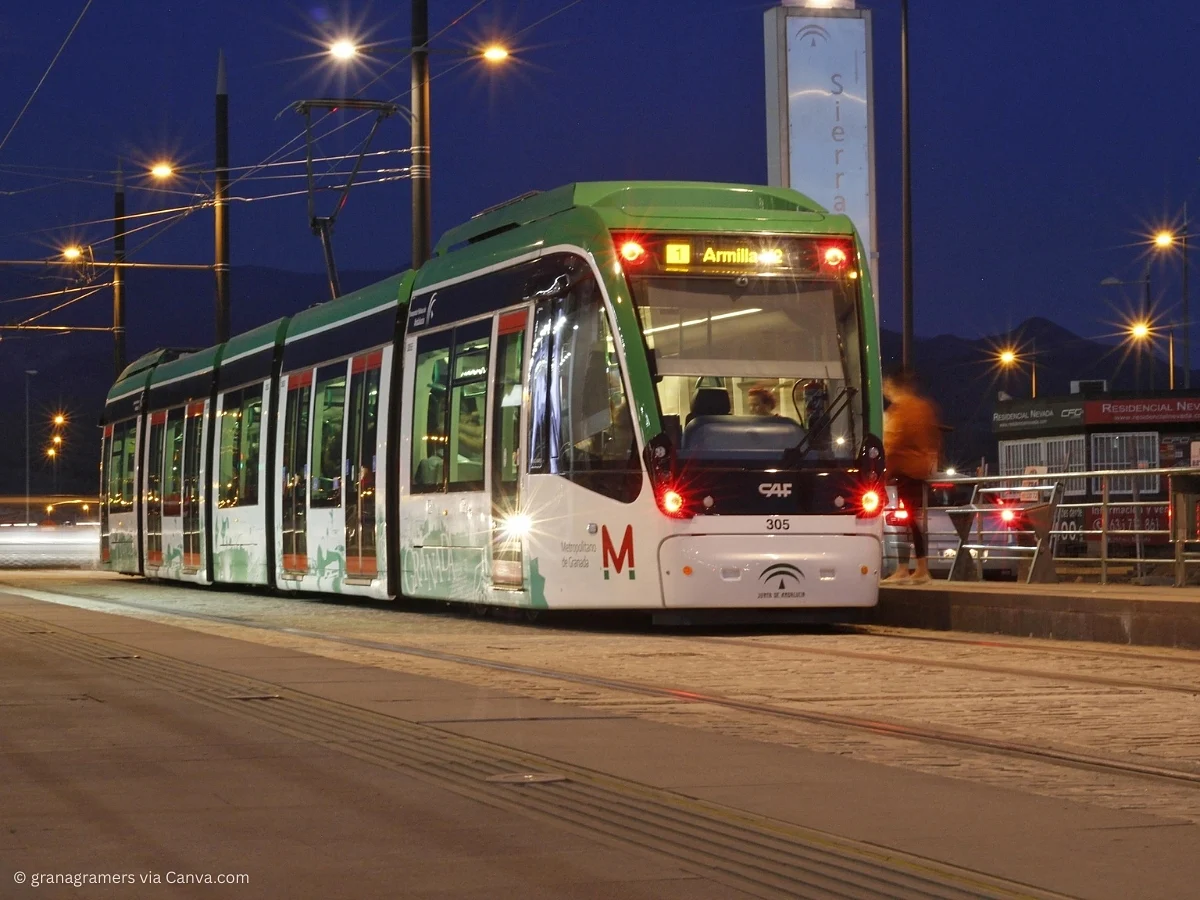
- Granada Metro: A single light metro line opened in 2017, connecting the university district and outlying areas to the city centre. Useful but limited for tourists staying centrally.
City Buses: The Underrated Option
City buses in Spain are frequently overlooked by tourists in favour of the metro, but they reach parts of cities the underground does not.
In Madrid, over 200 bus routes cover the entire city, with around 2,000 buses running daytime routes from 6am to 11:30pm. Night buses (the Buho, or owl, service) run 35 routes between 11:30pm and 6am, covering the most important areas.
- Madrid city buses (EMT): All are blue and accept contactless bank cards directly on board, as well as the Multi Card transport pass. Single journey from 1.50 euros.
- Barcelona city buses (TMB): Integrated with the metro and covered by the T-Casual card. Good for reaching neighbourhoods not served directly by metro lines.
- Seville city buses (TUSSAM): Cover the entire city and suburbs. Single journey around 1.40 euros. The C1 and C2 circular routes are particularly useful for tourists.
- Night buses in Madrid, Barcelona, and Seville run on reduced timetables but provide reliable coverage of main routes until the metro resumes at 6am.
Flight4 Top Tip: In Granada, where the metro is limited, city buses are the primary public transport option. Routes C31 (Albaicín - Centre) and C32 (Alhambra - Albaicín). Route C35 (Cementerio - Barranco Abogado).
3. Hop-On Hop-Off Tourist Buses
The Beginner's Best Friend
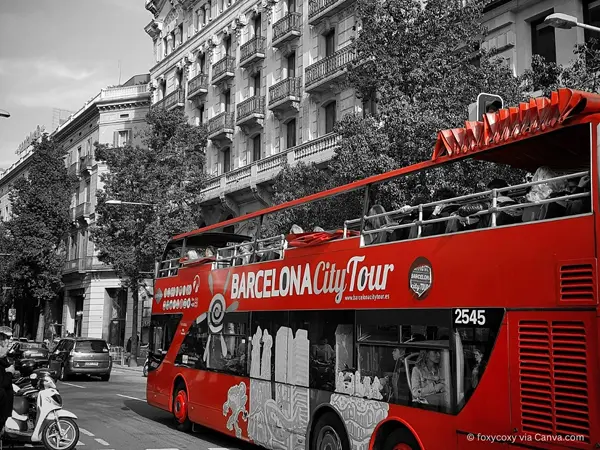
City Sightseeing and Barcelona City Tour operate hop-on hop-off double-decker buses in most major Spanish cities.
These are not the most cost-efficient transport option, but for a first day in an unfamiliar city they are genuinely useful. You can do a full circuit to get oriented, then hop off at the spots that interest you most on the second loop.
Madrid City Tour
- Operated by Madrid City Tour (officially backed by Grupo Julia and Alsa), the service runs three routes: Blue (Historical), Green (Modern), and the newer Orange (Present-day Madrid). Major sights include the Royal Palace, Prado Museum, Retiro Park, and Gran Via.
- Buy tickets at the first stop or in advance online.
- 24-hour tickets for adults (ages 16–64) are currently €33.00 at standard rates, though online discounts may bring this down to around €29.70.
Barcelona Bus Turistic
- The official hop-on hop-off service in Barcelona covers two routes (Red and Blue).
- One ticket covers all three. Starting point is Placa de Catalunya.
- Audio guide available in 16 languages.
- Good for reaching Sagrada Familia, Park Guell, Casa Batllo, and Montjuic in a single day.
- Ticket: around €33-€35 for 24 hours, prices depend on current seasonal offers.
Seville City Sightseeing
- Covers 14 stops including the Cathedral, Alcazar area, Plaza de Espana, Triana, and the Metropol Parasol.
- Runs from 10am to 8pm. Full circuit takes approximately 75 minutes.
- Tickets include discounts at several Seville attractions including the Flamenco Dance Museum and Seville Aquarium.
- Ticket: around €28-€30 for 24 hours, prices depend on current seasonal offers. Book online through City Sightseeing or GetYourGuide for best deals.
City Sightseeing also operates routes in Toledo, Cordoba, Granada, Malaga, Valencia, and Bilbao. For smaller cities like Toledo and Cordoba, the hop-on hop-off bus is a particularly good value option given the compact historic centres and limited public transport.
Key Tips for 2027:
- Book Online: Official websites almost always offer a 10% discount compared to buying at the bus stop.
- Check the App: Both major services now have real-time tracking apps to show exactly where the next bus is.
4. Transport Apps and Tickets
Practical Tips
The best ways to travel between Spanish citie. A list of useful transport apps and travel guides, plus tips on how to buy the best ticket deals.
Essential Apps:
- Citymapper: Available in Madrid, Barcelona, and Seville. Real-time public transport routing, including walking segments and fare information.
- Google Maps: Works reliably for public transport routing across Spain. Shows metro, bus, and train options with live departure times.
- Renfe App: Book and manage AVE and Cercanias tickets. Download tickets directly to your phone.
- Moovit: Good for bus and tram routing in smaller cities where Citymapper coverage is limited.
- ALSA App: Book long-distance coach tickets, view schedules, and manage bookings.
- Madrid Mobility 360: Multimodal route planning for Madrid, including BiciMAD electric bikes and real-time metro information.
Buying Travel Tickets in Spain: What Works Where:
- Madrid Tourist Travel Pass: Buy at any metro station ticket machine, at airport terminals T1-T4, or at CRTM offices at Sol and Atocha. From 10 euros per day for Zone A. Cards are loaded on the reloadable Multi Card.
- Barcelona T-Casual or Hola Barcelona: Buy at metro stations, TMB offices, or tourist information points. The Hola Barcelona unlimited pass is the better choice for tourists using transport heavily.
- Seville and Granada: No integrated tourist pass. Buy single tickets at bus stops or metro stations. Granada bus tickets cost around 1.40 euros per journey.
- AVE and long-distance trains: Always buy in advance through Renfe or Omio. Do not rely on station walk-ups for popular routes.
- Contactless bank cards are now accepted on Madrid city buses directly. This is the most convenient option if you do not want to buy a travel card. Note: you generally still need a physical Multi Card for the Madrid Metro.
Flight4 Pro Tip: Iryo and Ouigo train services often offer cheaper high-speed tickets on the same tracks. Checking an aggregator app like Trainline or Omio helps compare all three brands at once.
5. City-by-City Transport Options
How to get around Spain without a car
Madrid
The metro is the default choice for most journeys. The Tourist Travel Pass at €10.00 per day for Zone A is the best-value option for a city stay. Hop-on hop-off bus is worth doing for orientation on day one. Night buses (Buho) cover gaps when the metro closes.
Barcelona
Metro and bus are integrated. The Hola Barcelona pass or T-Casual card covers all journeys costing approximately €18.70 for 48 hours.. The hop-on hop-off Barcelona Bus Turistic covers Gaudi sites and Montjuic efficiently. Hire a Bike for the waterfront and flat city areas.
Seville
Seville's historic centre is compact enough to walk for most tourist sightseeing. However, Bus 32 is a helpful link between the Santa Justa Train Station and the central areas near Las Setas. The city bus network covers wider areas, and the single metro line is useful for reaching the Nervion shopping district (Metro Line 3 is currently under construction).
The hop-on hop-off City Sightseeing bus is the easiest way to reach Plaza de Espana and the Metropol Parasol without navigating buses individually. Taxis are affordable for evening returns from Triana.
Granada
The Alhambra hill is served by city bus routes. Route C30: Is the fastest direct link from Plaza Isabel la Católica to the Alhambra. Route C31: Connects the city centre to the Albaicín (San Nicolás viewpoint). Route C32: This is a circular route specifically designed to link the Alhambra and Albaicín directly. Taxis are recommended for Sacromonte after dark. No tourist transport pass exists. Pay per journey.
Smaller Towns on Day Trips
Both Toledo and Cordoba are easily reached via AVE or Avant high-speed trains from Madrid. Both have City Sightseeing hop-on hop-off services. Toledo's historic centre is entirely walkable. Cordoba's main sights are concentrated within 15-20 minutes walk of the main station.
Planning your trip? Explore our detailed guides Cheap Flights to Spain & Booking Tips - or Flight4's Spanish Attractions & Ticket Guide.
Please note: All prices are approximate, transport options are guidelines only, and information is subject to change without notice. Check current operational times, services, schedules, prices, and suitability directly with the transport provider.
More Tips on How to Travel Around Mainland Spain
Trams operate in 13 Spanish cities
For most tourists, the relevant networks are Barcelona, Valencia, and the Costa Blanca.
- Barcelona Tram (Trambaix and Trambescos): Two networks serving the western and northeastern suburbs. Integrated with metro and bus ticketing. Scenic ride through residential neighbourhoods not typically seen by tourists.
- Valencia Tram (Lines 6, 6, 8): Run along the coast and connect the city centre directly to Valencia's popular beaches, including Malvarrosa and Patacona. Line 3 runs to the beach. Cheap, reliable, and covered by the Valencia integrated transport card.
- Alicante Tram Metropolitano (TRAM): One of the most useful tourist tram systems in Spain. Line 9 runs from Alicante along the Costa Blanca coast through Benidorm to Denia, offering Mediterranean sea views the entire way. A genuinely scenic journey that doubles as a practical transport option for visiting multiple coastal towns. Pro Tip: To travel the full coast, use Line 1 from Alicante (Luceros) to Benidorm, then transfer to Line 9 for the journey from Benidorm to Denia.
Flight4 Pro Tip: The Alicante TRAM to Benidorm is a popular alternative to driving the Costa Blanca. The journey from Alicante to Benidorm costs around 4 euros and takes approximately 1 hour 20 minutes, with sea views for much of the route.
Connecting city centres to nearby towns and attractions
Cercanias is Spain's commuter rail network, operating in six major cities including Madrid, Barcelona, Valencia, Seville, and Bilbao. For tourists, it serves a specific and extremely useful purpose: connecting city centres to nearby towns and attractions without the cost of an AVE ticket.
- Madrid Cercanias covers 10 lines and connects the capital to towns including Alcala de Henares, Aranjuez, and El Escorial. Fares are cheap, typically 2-5 euros one way.
- Barcelona Cercanias (Rodalies) connects to Sitges (30 minutes), the Montserrat access point, and the airport.
- Seville Cercanias provides direct access from Santa Justa station to Dos Hermanas and nearby suburbs, useful for accessing accommodation outside the centre.
In Madrid, the Zone T tourist transport pass covers Cercanias within the Madrid region. This means day trips to Aranjuez, Alcala de Henares, and El Escorial are included within the cost of your tourist pass. No separate ticket required.
Flight4 Pro Tip: In Madrid, a Zone T tourist pass costs from €35.40 per day and includes unlimited Cercanias within the region. If you plan any day trips by commuter rail, upgrade from Zone A to Zone T.
Several Spanish cities operate cable cars or funiculars that qualify as both transport and tourist attractions. These are not the most practical ways to get around, but they offer perspectives of each city that no other transport provides.
1. Madrid Teleferico
The Teleferico de Madrid connects Parque del Oeste (near the Temple of Debod) to the Casa de Campo park, travelling 2.5 kilometres in approximately 11 minutes. It offers aerial views over the Royal Palace, the Manzanares River, and western Madrid.
Note: This cable car service is undergoing reconstruction works and is due to reopen early 2028. Check the official website (esmadrid.com) or the Teleferico Madrid site for current opening status before visiting.
Flight4 Pro Tip: You can still visit the Casa de Campo park or the Temple of Debod, but the aerial link between them is unavailable.
2. Barcelona Montjuic Cable Car & Funicular
Two separate services operate on Montjuic hill in Barcelona. The Montjuic Funicular runs from Paral-lel metro station up to the Montjuic gardens and castle area.
The Montjuic Cable Car (Teleferic de Montjuic) then carries passengers from the funicular upper station to the castle at the hilltop. Both offer excellent views of the city and port. The funicular is covered by standard TMB transport tickets. Price: €17.10 if booked online (or €19.00 at the ticket office).
3. Barcelona Port Cable Car (Transbordador Aerial del Port)
This older cable car stretches from the Barceloneta beach area to Montjuic, crossing directly over the port and harbour.
It operates at a height of 75 metres and provides one of the best bird's-eye views of Barcelona available. Not covered by standard transport tickets. Entry around One way: €12.50 Round trip: €20.00.
Water transport is a small but genuinely enjoyable element of getting around parts of Spain.
1. Seville: The Guadalquivir River Boat
Several operators run tourist boat trips along the Guadalquivir River in Seville, departing from near the Torre del Oro.
These are sightseeing cruises rather than functional transport, but they provide an unusual perspective on the city from the waterway that defined its history as a major port. Cruceros Torre del Oro operates regular departures. Duration: 1 hour. Price: around €17–€22 per adult. Book through GetYourGuide or directly at the dock.
2. Barcelona: Port Vell & Catamaran
Tourist catamarans and small ferries operate in Barcelona's Port Vell, with scenic trips around the harbour and to the breakwater.
The Las Golondrinas service has operated from the foot of La Rambla since 1888. A 40-minute tour costs around 8-10 euros.
3. Island Ferries
Baleària, Trasmed GLE (part of Grimaldi Group), and Grandi Navi Veloci (GNV) operate ferry routes between mainland Spain and the Balearic Islands (Mallorca, Menorca, Ibiza, Formentera). The Valencia to Palma ferry takes around 8 hours overnight. Book well ahead in summer.
1. Safety on Public Transport
- Pickpocketing is the main concern. Be attentive at busy metro stations, on crowded buses, and at major tourist transport hubs like Barcelona Sants and Madrid Atocha. Other high-risk areas include Metro Line 4 (Yellow) in Barcelona and any line serving the airport or major tourist sites like Sagrada Familia.
- Keep your phone, wallet, and passport copies in front pockets or zipped inner compartments.
- On AVE trains, keep bags in overhead racks visible from your seat. Important: Across most European networks, if using end-of-carriage racks, it is wise to "eyeball" your bag whenever the train stops at intermediate stations (unfortunately, station bag snatching still occurs).
- Tourist transport hubs attract persistent unofficial tour sellers and occasionally aggressive charity collectors. A polite but firm refusal "No, gracias" is fine.
- On quiet metro carriages late at night, use busier carriages rather than isolated ones.
2. Etiquette
- On AVE trains and Cercanias, quiet zones are common. Keep phone calls short and voices low.
- Always validate your ticket or tap your card before boarding metro or tram services. Inspectors do operate and fines start around 100 euros - tourist or not.
- Give up priority seats near the doors on buses and metro for elderly passengers and those with young children.
- Stand to the right on escalators to allow others to pass on the left.
Spain: Transport in Pictures


Frequently Asked Questions: Getting Around Spain using Public Transport
Planning a Trip to Spain?
Smart travel plans starts here: these FAQs simplify transport, saving time and money.
1. What is the best way to travel around Spain as a tourist?
The best way to travel around Spain is by combining high-speed AVE trains for intercity journeys and metro systems for city travel. Trains are fast, comfortable, and connect major cities like Madrid, Barcelona, and Seville in under three hours, while metros and buses provide affordable and efficient local transport.
2. Is public transport in Spain good for tourists?
Yes, Spain has one of the best public transport systems in Europe. It is reliable, affordable, and well-connected, with extensive metro networks, high-speed trains, and long-distance coaches reaching most cities and towns.
3. Are trains or buses better for travelling between cities in Spain?
High-speed trains (AVE) are generally the best option for speed and comfort, especially for routes under three hours. Buses, operated by companies like ALSA, are cheaper and useful for smaller towns not served by rail.
4. How far in advance should you book trains in Spain?
You should book train tickets at least one week in advance for standard travel and up to three to four weeks ahead during peak seasons. Early booking can significantly reduce ticket prices compared to same-day fares.
5. Do tourists need a travel pass for public transport in Spain?
Travel passes are highly recommended (especially for active tourists) in cities like Madrid and Barcelona. Options such as the Madrid Tourist Travel Pass or Barcelona Hola Card offer unlimited travel and are often more cost-effective than single tickets.
6. Can you use contactless payment on public transport in Spain?
Contactless payment is widely accepted on city buses in places like Madrid, but some metro systems still require a physical travel card. It is best to carry both a contactless card and a local transport card when travelling.
7. Is it easy to get from Spanish airports to city centres?
Yes, most major Spanish airports are well connected to city centres by metro, train, or bus. For example, Madrid and Barcelona both have direct metro lines from the airport, making transfers quick and affordable.
8. Are hop-on hop-off buses worth it in Spain?
Hop-on hop-off buses are useful for first-time visitors who want an overview of a city. While they are more expensive than public transport, they provide convenient access to major attractions and include audio guides.
9. What apps should tourists use for transport in Spain?
Popular transport apps in Spain include Google Maps for navigation, Citymapper for real-time routes in major cities, and the Renfe and ALSA apps for booking trains and long-distance buses.
10. Is public transport in Spain safe for tourists?
Public transport in Spain is generally very safe. The main risk is pickpocketing in crowded areas such as metro stations and tourist hubs, so travellers should keep belongings secure and stay aware of their surroundings.
Disclaimer
Articles, Guides & Advisories
All information provided is for guidance only. We aim to keep information current and accurate; however, it can change without notice. Please see our Site Disclaimer and travel and booking advice pages for details. Flight4 may earn a commission; please see our Affiliate Statement for details.
About the Author
Plan Your Spain (mainland) Trip
Book With Our Partners
Some links below are affiliate links; we may earn a commission at no extra cost to you. Each service is booked directly with its provider, on their terms. Flight4 does not sell or organise travel, or offer these as a package or combined travel arrangement. Affiliate Statement
Personalises the options below

How we score car hire platforms
Compare car hire suppliers for getting around Spain (mainland) and the wider region.
Compare Spain (mainland) Car Hire
How we score tour and ticket platforms
Skip-the-line tickets and guided tours across Spain (mainland), bookable instantly online.
View Spain (mainland) Tours
Compare central Spain (mainland) hotels with free cancellation on most rooms.
View Spain (mainland) Hotels
Compare hundreds of airlines for the cheapest route into Spain (mainland).
Search Spain (mainland) Flights
How we score airport transfer platforms
Pre-booked airport transfers to and from Spain (mainland), at a fixed price with flight tracking.
View Spain (mainland) Transfers